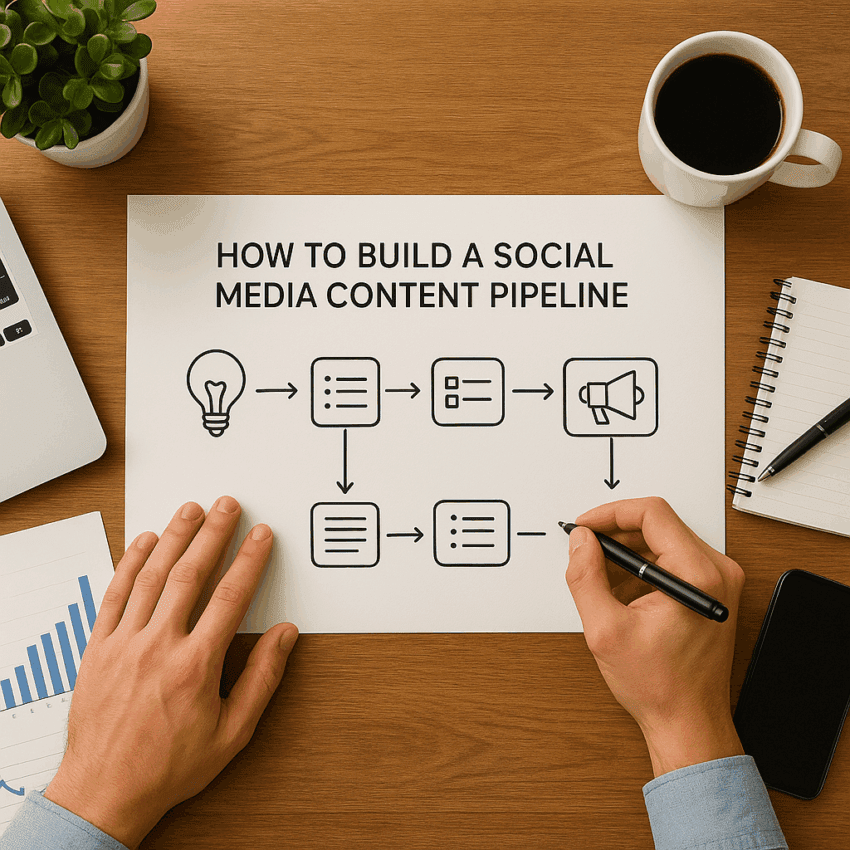
A well-designed social media content pipeline turns scattered ideas into repeatable outcomes. It lays out how your brand researches topics, creates assets, secures approvals, publishes confidently, engages with people, and learns from results to improve the next sprint. Whether you manage a single founder-led account or a global brand with dozens of markets, a pipeline reduces chaos, speeds execution, and protects quality. With more than five billion people actively using social platforms worldwide and average users spending over two hours per day on them, the opportunity—and the noise—are both immense. A pipeline is how you earn attention without burning out your team or your budget.
What a Social Media Content Pipeline Is and Why It Matters
Think of a pipeline as a system that turns inputs (insights, briefs, assets) into outputs (posts, stories, videos) and outcomes (reach, engagement, leads, sales). It’s not just a calendar; it is a living operating model connecting goals to daily actions. Done right, it delivers three compounding advantages:
- Predictable quality: Creative and copy adhere to your voice, accessibility standards, and brand guardrails.
- Operational speed: Clear swimlanes and SLAs reduce back-and-forth, so trends and tentpoles are met on time.
- Learning loop: Integrated measurement makes every post a micro-experiment that improves the next sprint.
For leaders, the pipeline surfaces trade-offs (speed vs. risk, volume vs. depth) and shows how resources map to outcomes. For creators, it reduces cognitive load with templates, naming conventions, and reusable components. For legal and compliance, it provides traceability from concept to publish.
Why the urgency? Social platforms now mediate discovery, culture, and customer support. Video formats and recommendation feeds (e.g., Reels, Shorts) reward freshness and watch time. Without a pipeline, brands either ship too slowly to matter or sacrifice quality for speed. A pipeline lets you pursue both.
Core concepts to anchor the system include a clear content strategy, relentless consistency in execution, a well-documented workflow, high-fidelity analytics, deep understanding of your audience, thoughtful governance, purposeful automation, scalable repurposing, disciplined experimentation, and an obsession with ROI.
Pipeline Architecture: From Strategy to Iteration
The following blueprint breaks the pipeline into interconnected stages. Treat each stage as a gate with defined inputs, tasks, tools, roles, and outputs. You can adapt the fidelity based on team size and regulatory needs.
1) Goals and Strategic Guardrails
- Inputs: Business objectives, brand positioning, competitive landscape, target segments, budget.
- Tasks: Translate company goals into platform-specific outcomes (e.g., awareness vs. demand capture). Choose a small set of North Star metrics and supporting diagnostics.
- Outputs: Social strategy one-pager, measurement framework, risk appetite, brand voice and tone guide, content pillars.
2) Audience, Channels, and Journeys
- Inputs: Customer research, social listening, search trends, CRM insights, prior campaign data.
- Tasks: Build audience narratives and jobs-to-be-done. Map channel roles (e.g., TikTok for reach, LinkedIn for credibility, Instagram for community, YouTube for depth).
- Outputs: Audience playbooks, channel charters, community guidelines, inclusive-language rules, accessibility standards.
3) Content Pillars and Message House
- Inputs: Differentiators, product roadmap, seasonal calendar, industry tentpoles.
- Tasks: Define 4–6 pillars (education, product, culture, community, social proof, thought leadership). Build a message house per pillar (key point, proof, example, CTA).
- Outputs: Pillar matrix mapping to audience needs and funnel stages, example posts, approved claims and disclaimers.
4) Editorial Planning (Quarterly/Monthly/Weekly)
- Inputs: Pillars, campaign briefs, tentpole dates, resource capacity, creative backlog.
- Tasks: Allocate post volume per pillar and channel. Balance always-on content with campaign and reactive slots. Define test cells (e.g., hook variants, lengths, CTAs).
- Outputs: Editorial calendar, weekly sprint plan, creative queue, test plan, resource allocations.
5) Ideation and Creative Briefing
- Inputs: Data-backed insights, audience prompts, brand narratives.
- Tasks: Run structured brainstorms: problem-solution stories, behind-the-scenes, UGC prompts, expert Q&A, myths vs. facts, before/after, listicles, duets/remixes.
- Outputs: Briefs with objective, audience tension, big idea, storyboard, format specs, assets needed, approval path, risks, success criteria.
6) Production (Modular by Design)
- Inputs: Approved briefs, asset libraries, templates, talent availability.
- Tasks: Shoot or design assets; capture multiple takes and aspect ratios; record clean audio; transcribe; produce variants (15s, 30s, 60s). Craft platform-native hooks and CTAs.
- Outputs: Master asset + components (visuals, captions, B‑roll, thumbnails, subtitles, alt text), rough and final cuts, caption banks, hashtags strategy, link and UTM plans.
7) Quality Assurance, Accessibility, and Compliance
- Checklist: Brand alignment, legal claims, copyright/usage rights, model releases, music licensing, alt text, captions, color contrast, safe-area framing, fact-check, policy review.
- Outputs: QA sign-off, compliance log, asset rights registry, risk notes.
8) Approvals and Governance
- Inputs: Final cut, QA checklist, copy and hashtags, metadata.
- Tasks: Route through RACI model (Responsible, Accountable, Consulted, Informed). Set SLAs (e.g., 24h for editorial, 48h for legal).
- Outputs: Approval record with versioning, timestamped decisions, publish window assignment.
9) Scheduling and Publishing
- Inputs: Approved assets, time windows, platform specs, targeting rules.
- Tasks: Schedule natively or via a tool; add UTMs; set audience restrictions if needed; stage platform-specific copy and hashtags; localize if required.
- Outputs: Published posts with IDs, links, and UTM parameters; platform API confirmations.
10) Community Management
- Inputs: Live posts, inbound comments/DMs, sentiment feed, FAQ library.
- Tasks: Respond within SLA; escalate edge cases; tag themes; harvest UGC permissions; run surprise-and-delight plays.
- Outputs: Response logs, tagged conversation data, community insights, advocate lists.
11) Measurement, Insight, and Reporting
- Inputs: Platform analytics, web analytics, CRM attribution, social listening, cost data.
- Tasks: Normalize data; compute engagement rate by reach (interactions divided by reach); track VTR, watch time, saves, shares, cost per result, creative fatigue.
- Outputs: Weekly pulse report, monthly deep-dive, narrative insights, recommendations, backlog updates.
12) Iteration and Knowledge Management
- Inputs: Insights and test results; content inventory.
- Tasks: Promote learnings to standards (e.g., hooks under 120 characters, first frame motion, CTA after 3–5 seconds). Archive assets and tag reusable elements.
- Outputs: Updated playbooks, revised templates, prioritized test backlog, repurposing plan.
Tooling and Automation Without the Bloat
Choose tools that reduce friction, not add it. Start simple and scale as complexity grows.
- Listening and research: Social listening for themes, search trend tools, competitor audits.
- Asset management: A DAM with versioning, usage rights, and expiration alerts.
- Collaboration: Kanban boards, brief templates, approval routing, audit trails.
- Creative: Mobile-first video editors, captioning, thumbnail generators, auto-subtitles.
- Scheduling: Native schedulers for platform features; consolidated tools for governance and reporting.
- Analytics: Dashboards that combine platform data with web and CRM events; UTM builders.
- AI assistance: Transcription, rough cuts, caption drafts, alt text suggestions, image scaling—always human-reviewed.
Use lightweight APIs or zaps to move metadata automatically (e.g., brief ID into video filename; publish date into UTM campaign). Reserve deep integrations for recurring, high-value tasks.
Governance, Risk, and Compliance
Strong governance liberates creativity by clarifying what is non-negotiable.
- RACI and SLAs: Define who approves what, and how fast.
- Copyright and licensing: Track usage rights for music, fonts, stock, and UGC; maintain releases.
- Claims and disclosures: Regulated industries need substantiation, disclaimers, and influencer disclosures.
- Privacy: Do not share personal data in public comments; follow data retention rules.
- Accessibility: Captions, alt text, readable contrast, motion sensitivity notes.
- Crisis playbook: Triage levels, spokespersons, holding statements, takedown procedures, after-action reviews.
Resourcing and Roles
Small teams often multitask; larger teams can specialize. Consider a spine-and-spoke model.
- Spine (core): Strategist, Social Manager, Copywriter, Designer/Editor, Community Manager, Analyst, Legal/Compliance reviewer.
- Spokes (specialists): Motion graphics, influencer lead, localization lead, paid social buyer, SEO/YouTube specialist.
- Service levels: Example SLA—ideation 2 days, production 3 days, approvals 2 days, publish windows set 1 day ahead; urgent lane for trend response within same day.
Operational Standards and Templates
Standardization reduces errors and accelerates onboarding.
- File naming: YYYYMMDD_channel_pillar_briefID_variant_v01.mp4
- Metadata sheet: Brief ID, owner, audience, pillar, platform, aspect ratio, hook text, CTA, UTM, rights expiry.
- Creative brief: Objective, insight, key message, proof, CTA, success metric, risks, timeline, approvers.
- Pre-publish checklist: Hook strength, caption clarity, time-to-value, logo use, subtitles, alt text, link test, platform tags, end-card visibility.
- Editorial calendar: View by week (slots), by pillar (balance), by test (A/B cells), by region.
Measurement Framework and Realistic Benchmarks
Metrics must map to intent. A post can “perform” and still not move the business. Separate health metrics from outcome metrics.
- Reach and efficiency: Impressions, unique reach, cost per thousand (for paid), frequency, share of voice.
- Engagement quality: Engagement rate by reach = total interactions divided by reach; saved posts, shares, comments-to-likes ratio.
- Video depth: 3-second views, 50% and 95% completions, average watch time, replays.
- Traffic and conversion: Clicks, sessions, bounce, assisted conversions, lead quality, pipeline value.
- Brand signals: Lift studies, search demand changes, sentiment, creator affinity, community growth rate.
Set directional benchmarks by channel and format, but use rolling baselines: compare each post to its pillar and platform median over the last 90 days. Flag creative fatigue when engagement rate drops 30% below median for three consecutive posts in the same variant.
Building for Speed: Cadence, SLAs, and Lanes
Speed comes from clarity and repetition. Use lanes to separate predictable work from fast-turn items.
- Always-on lane: Predictable outputs (e.g., three Reels, two carousels, one YouTube Short per week).
- Campaign lane: Seasonal or product launches with higher production value and longer lead times.
- Reactive lane: Trend or news hijacks with pre-cleared guardrails; same-day publish possible.
Sample weekly rhythm:
- Monday: Review last week’s insights, lock variants, assign briefs.
- Tuesday–Wednesday: Production sprints; daily stand-ups; rough cut reviews.
- Thursday: Finalize, QA, approvals, schedule next week.
- Friday: Community deep dive, backlog grooming, test design.
Scaling Content Through Atomization and Localization
Turn one big idea into many native pieces. That’s how volume and quality coexist.
- Atomization: From a 3-minute hero video, cut 6–8 Shorts/Reels, 3 GIFs, 10 stills, a carousel, a blog summary, and a newsletter snippet.
- Native adaptation: Change hooks, pacing, captions, and aspect ratios per platform; avoid one-size-fits-all exports.
- Localization: Transcreate, don’t just translate; swap cultural references, pricing, screenshots, compliance notes; maintain a glossary and translation memory.
- Evergreen library: Tag assets as evergreen vs. time-bound; refresh thumbnails and hooks quarterly to reset performance.
AI in the Pipeline: Assist, Don’t Autopilot
AI can accelerate grunt work but requires guardrails. Use it to draft captions, summarize long videos, generate alt text, cluster comments by theme, and propose test variants. Keep humans for taste, accuracy, and accountability. Build an AI prompt library tied to your brand voice and compliance constraints, and log any AI-assisted output for traceability. Always verify facts and rights before publishing.
Change Management and a 90-Day Rollout Plan
Adopting a pipeline is as much about behavior as it is about documents. Start with thin slices, not a big-bang overhaul.
- Days 1–30: Define goals, pillars, roles, RACI, and a minimal calendar. Pilot the pre-publish checklist on one channel. Stand up a single source of truth (drive or DAM).
- Days 31–60: Add briefs and test plans. Integrate UTMs. Launch weekly insights review. Introduce a reactive lane with guardrails.
- Days 61–90: Expand to more channels, formalize SLAs, roll out dashboards, and start asset atomization. Run a retrospective and prune steps that add little value.
Common Pitfalls and How to Avoid Them
- Vanity over value: Chasing viral spikes that do not map to business outcomes. Tie creative to measurable intents.
- Tool sprawl: Too many overlapping platforms. Consolidate quarterly.
- Approval bottlenecks: Undefined SLAs cause missed moments. Pre-clear safe content types and claims.
- One-size-fits-all edits: Ignoring platform norms kills watch time. Recut for pace and framing.
- Insight theater: Pretty dashboards, no decisions. Mandate one recommendation per chart.
- Ignoring accessibility: It’s both the right thing and a reach multiplier. Bake captions and alt text into production.
- No content retirement plan: Fatigue sets in. Rotate variants and refresh creative systematically.
Mini Example: From Brief to Business Result
A D2C wellness brand wants to grow trial sign-ups. Goal: lower cost per trial while maintaining brand safety. Pillar: education. Brief: debunk three hydration myths with a registered dietitian. Production: 45-second hero explainer, six Shorts, a carousel, and ASMR-style B‑roll. Compliance: claims substantiated, disclaimers added, music licensed. Approvals: 48-hour SLA met. Publishing: UTMs tied to a dedicated landing page, paid amplification to retarget engaged viewers. Community: pin expert responses, crowdsource questions for part two. Measurement: 30% higher average watch time vs. baseline; saves-to-likes ratio up 40%; cost per trial down 18% due to improved retargeting pools. Iteration: keep expert-on-screen framing, shorten first myth to 12 seconds, add progress bar overlay.
Practical Checklists You Can Use Today
Pre-Ideation (Monthly)
- Update audience tensions and FAQs from support and community.
- Pull top 10 performing assets and identify common hooks and structures.
- Review tentpoles and seasonal moments; confirm production capacity.
Pre-Production (Per Asset)
- Confirm objective, audience, and single-minded message.
- Decide aspect ratio and platform-native features (duet, stitch, carousel, poll).
- Secure rights and releases; plan captions and alt text.
Pre-Publish (Per Post)
- Test hook clarity in under five seconds.
- Verify captions and disclaimers; check links and UTMs.
- Schedule at audience-active windows; stage community responses.
Post-Publish (Weekly)
- Analyze top/bottom 10% by watch time and saves; harvest learnings.
- Rotate creative to avoid fatigue; refresh thumbnails and first frames.
- Capture UGC rights and feed the evergreen library.
A Note on Scale, Spend, and Payback
Not every team needs a complex setup. The right size is the smallest system that delivers repeatable outcomes. A lightweight pipeline with clear goals, an organized asset library, a weekly calendar, a pre-publish checklist, and a basic dashboard can double throughput without new headcount. As you scale, invest where bottlenecks hurt most: approvals, video editing capacity, or analytics. Measure payback in time saved per asset, reduced rework, faster time-to-publish, and improved effectiveness per dollar.
Where the Market Is Headed
Recommendation feeds keep raising the bar on creative freshness and depth of engagement. Short-form video remains powerful, but long-form explainer content is experiencing a renaissance on platforms that reward session time. Social commerce and messaging-based support are merging into the customer journey. Teams that treat their pipeline as a product—versioned, documented, and continuously improved—will adapt faster to algorithm shifts, new formats, and privacy changes.
Putting It All Together
Build a pipeline that links purpose to process. Start with a crisp definition of success; focus pillars on audience needs; set a weekly cadence you can sustain; produce modular assets; protect quality with checklists; and close the loop with data that sparks better creative, not just bigger reports. With a system in place, your team stops fighting the calendar and starts compounding outcomes—turning every post into a stepping stone for the next one.