If your editorial calendar relies only on last month’s performance, you are already late. Pinterest’s unique vantage point—where people plan what to do, buy, and make next—lets you spot ideas before they spike elsewhere. This guide shows how to use the Pinterest Trends tool to mine audience demand, turn trend curves into concrete content ideas, and build a repeatable system that feeds your blog, social posts, videos, emails, and product launches with timely relevance.
Why Pinterest Trends is a goldmine for content ideation
Most social networks are built for performance in the moment: reactive feeds, fleeting memes, and engagement that decays within hours. Pinterest is different. It is a planning platform. People arrive with intent to discover, save, and later act on ideas—a behavior pattern that produces early signals you can operationalize across channels.
Consider a few benchmarks that underscore this opportunity. Pinterest reported more than 520 million monthly active users in mid‑2024 (Pinterest Investor Relations), continuing steady growth after 2023’s rebound. Pinterest internal data has long shown that about 97% of top searches are unbranded, which means searchers are open to discovering new creators and products rather than looking for specific brand names. And the company’s annual Pinterest Predicts program has publicly claimed around 80% accuracy for the trends it spotlights, reinforcing that the platform’s forecasting signal tends to materialize across culture and commerce.
For content strategists and social media teams, this environment is ideal. While a TikTok sound may explode overnight and disappear just as fast, Pinterest lets you see the curve that precedes a breakout—seasonal build‑up, micro‑niche momentum, or lifestyle shifts reflected in saved Pins. That foresight gives your team time to research, produce, and publish richer assets that win on search, social, and even email because you are aligning with demand as it grows, not after.
There’s also a compounding effect: high‑quality Pins earn saves over months or years, seeding ongoing discovery in a way few networks enable. That durable distribution works especially well for categories like food, home, fashion, beauty, wellness, DIY, travel, and personal finance, where tutorials and inspiration keep serving audiences long after the first post date.
Getting oriented in Pinterest Trends
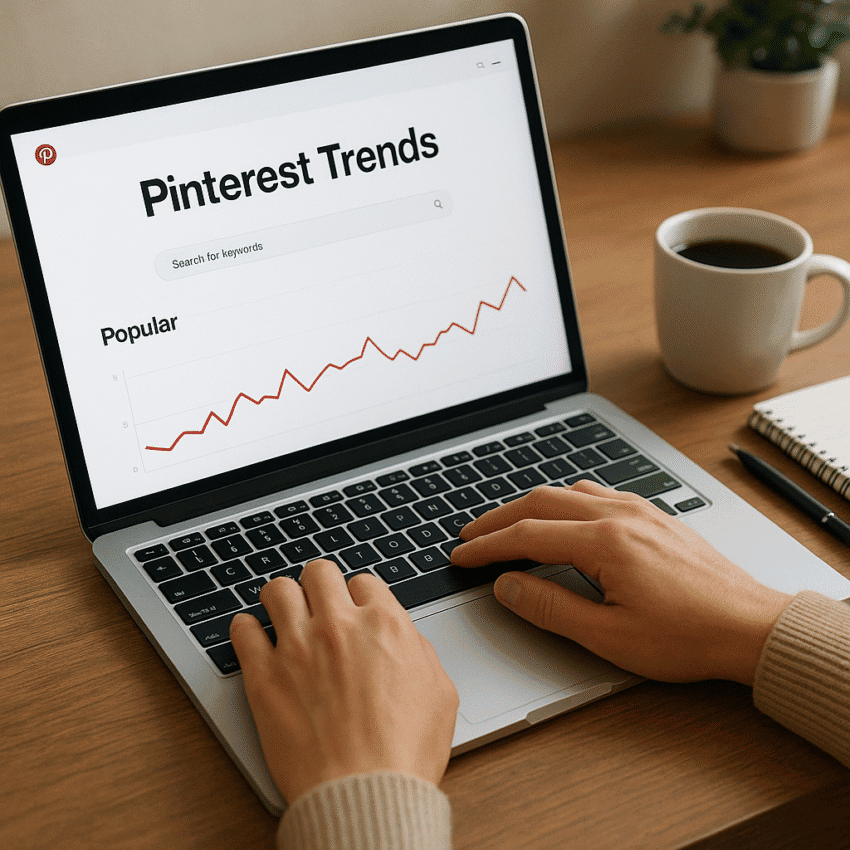
The Pinterest Trends interface is designed for quick pattern recognition. You can enter a keyword, compare multiple queries, filter by market, and scan related terms to widen or narrow your angle. The graph visualizes interest over time, making it easy to spot rising topics, repeating seasonal waves, and sudden spikes.
Essential steps
- Open trends.pinterest.com (or access Trends inside the Pinterest Business hub) and choose your primary market to ensure cultural and seasonal relevance.
- Search a core term—e.g., “capsule wardrobe,” “balcony garden,” “meal prep,” or “entryway decor.”
- Compare with adjacent queries to test angles: “spring capsule wardrobe,” “minimalist capsule wardrobe,” “work capsule wardrobe.”
- Scan the “Related trends” list to map subtopics and long‑tail keywords you can own.
- Note the timespan of rising interest: does the curve build for weeks or peak suddenly? This informs your production lead time.
- Save standout terms in a shared spreadsheet with columns for search term, direction (rising/peaking), potential formats, and publishing window.
Reading the graph like a strategist
- Seasonal wave: Repeatable patterns (e.g., “grill recipes” each May–July, “Halloween makeup” each September–October) are ideal for annual refreshes and evergreen libraries.
- Emergent growth: A steady multi‑month climb (e.g., “cottagecore bedroom,” “quiet luxury outfits”) suggests a lifestyle shift worth deeper coverage.
- Spike and fade: Fast surges (e.g., a viral recipe or decor hack) may justify rapid micro‑content and repins, but invest cautiously in long‑form.
- Plateau: A topic that holds steady interest is a candidate for pillar pages, how‑to hubs, and email evergreen sequences.
From signals to standout ideas
Trends without translation are just charts. The payoff comes when you convert curves into specific concepts, formats, and calls to action your audience can immediately use. Start with the demand language you see in Trends, then generate a matrix of ideas that ladder up to your positioning.
Idea frameworks you can rinse and repeat
- Problem–solution: “No‑space balcony garden? 7 vertical planters that actually work.”
- Checklist: “Spring capsule wardrobe: 12 pieces, 36 outfits.”
- Makeover: “Entryway decor before/after with renter‑safe updates.”
- Budget vs. splurge: “Minimalist home office for $200 vs. $2,000.”
- Starter kit: “Meal prep basics: containers, batch recipes, and labeling.”
- Seasonal series: “Week‑by‑week Halloween makeup looks from subtle to show‑stopping.”
- Beginner to advanced: “Sourdough timeline: your first loaf to laminated pastries.”
Cross‑pollinate niches
Use related trend clusters to invent new combinations. If “coastal grandmother” and “linen outfits” trend together, test “coastal grandmother capsule wardrobe.” If “Asian pantry staples” rises alongside “one‑pan dinners,” try “One‑pan Asian pantry meals for busy weeknights.” These mashups often have less competition and stronger save‑rates because they feel personalized to a micro‑identity.
Translate keywords into multi‑format content
- Standard Pin: A vertical hero image with a concise text overlay and a clear benefit (“7 renter‑safe entryway updates”).
- Short video: 15–45 seconds showing the transformation or recipe steps with tight cuts and captions.
- Carousel: Step‑by‑step tutorial or before/after series for projects that benefit from sequencing.
- Idea-style multi‑page Pin: Break down a process into scannable frames; link to your full post or product collection if available.
- Long‑form blog/video: Deep dive that captures search traffic, embeds your Pins, and houses lead magnets.
- Email: Round‑up of top Pins plus behind‑the‑scenes tips that didn’t fit the caption.
Build a 52‑week calendar from Pinterest Trends
Publishing on time is non‑negotiable on Pinterest. Many categories require a lead of multiple weeks. If the graph peaks in early October for “pumpkin decor,” begin seeding content in late August to accumulate saves and reach. A practical rule of thumb is to start posting four to eight weeks before the historical high point for your term, then escalate the volume as the curve rises.
Lead–peak–tail planning
- Lead phase (T‑8 to T‑5 weeks): Foundational guides and starter kits; build internal links and collections.
- Build phase (T‑4 to T‑2 weeks): Specific tutorials, shopping lists, and comparison content; diversify formats.
- Peak week (T‑1 to T+1 weeks): Daily quick‑hit posts, refreshes of top performers, and retargeting ads.
- Tail phase (T+2 to T+4 weeks): Recaps and “save for next year” content; solicit user‑generated examples.
Operationalize this by mapping each priority trend to dates and deliverables. Add owner names, asset checklists (images, short video, captions, URLs), and approvals. When you rinse this rhythm across holidays (Valentine’s Day, Ramadan, Easter, graduation, summer travel, back‑to‑school, Halloween, Diwali, Thanksgiving, Christmas, New Year), you create an annual drumbeat that reduces last‑minute scrambling.
Pinterest SEO that compounds
The same research you do in Trends should shape your Pin metadata and on‑site content. Use the demand language the audience uses so your assets appear for both on‑Pinterest search and external engines.
- Pin title: Front‑load the key term and add a concrete benefit (“Capsule wardrobe for teachers: 12 pieces to mix all semester”).
- Description: 1–3 natural‑language sentences that weave secondary terms; end with a soft CTA to click or save.
- Text overlay: Short, legible, high‑contrast; think benefit plus specificity (“Small balcony garden that survives heat”).
- Board strategy: Create boards that reflect trend clusters, not just brand categories; keep board descriptions descriptive.
- Site alignment: Mirror your Pin keywords in the destination page H1/H2, meta description, image alt text, and schema where relevant.
Hashtags are less central on Pinterest than on other platforms; rely on search‑friendly phrasing over tag stuffing. Use clean URLs and UTM parameters so you can attribute performance across analytics platforms without breaking the user experience.
Creative that earns saves and clicks
Visuals are your hook; the trend is your timing. Optimize both. Vertical 2:3 aspect ratio (e.g., 1000×1500px) remains a safe default. Prioritize clarity over complexity: a single subject, ample negative space, and a text overlay that lands a promise without crowding the frame.
- Contrast and legibility: Ensure overlay text passes accessibility standards; test on small screens.
- Branding: Include a subtle logo or URL so your work is recognizable when repinned outside your boards.
- Motion: Short, purposeful motion often outperforms static when demonstrating steps or reveals.
- Human presence: Hands‑in‑frame or try‑on clips can boost credibility for tutorials and style content.
- Thumbnail discipline: For multi‑page or video Pins, the first frame must communicate the outcome clearly.
Avoid generic stock looks in trend‑heavy categories; the fastest way to lose the save is to look like everyone else. Aim for specificity: show the exact small bathroom storage solution, the precise spice blend, the side‑by‑side outfit swaps. Specificity converts.
From insights to ROI: metrics that matter
Track the signals that align with planning behavior. Saves indicate future action; clicks reflect immediate curiosity; time on page and sign‑ups reveal depth of value. On Pinterest, a high save‑rate can compound reach as your content re‑circulates through boards over time.
- Core KPIs: impressions, saves, outbound clicks, save‑rate (saves/impressions), click‑through rate, engaged audience.
- On‑site KPIs: session duration, scroll depth, conversions (email sign‑ups, purchases), assisted conversions.
- Attribution hygiene: use UTMs consistently; align Pinterest metrics with your web analytics to assess true downstream value.
If you run commerce or lead generation, implement the Pinterest Tag for deeper funnel tracking and retargeting pools. Pair organic insights with lightweight paid support against rising trends to lock in visibility during peak weeks; even modest budgets can meaningfully amplify discoverability when timed well.
Advanced: triangulate Pinterest with other data
To separate signal from noise, cross‑reference Trends with tooling you already use:
- Google Trends: Confirms whether a topic is breaking into broader awareness; helpful for timing blog SEO and YouTube titles.
- Search Console: Reveals how your site is already capturing related queries you can reinforce with new Pins.
- Social listening: Monitors sentiment and language shifts on TikTok, Instagram, Reddit; informs creative tone.
- Merchant data: If you have a catalog, track add‑to‑cart rate by collection and promote what aligns with rising search terms.
- Email engagement: If a trend‑aligned newsletter segment outperforms baseline, spin the theme into more content and Pins.
For macro planning, review the annual Pinterest Predicts report to spot directionally important themes. Even if you do not chase every headline trend, the taxonomy reveals how people frame evolving identities, aesthetics, and rituals—raw material for campaigns and product positioning.
Team workflows that scale
A great insight dies in a DM. Systematize how your team captures and ships ideas so Pinterest Trends becomes a weekly ritual rather than a sporadic scramble.
- Source of truth: Maintain a shared spreadsheet or Notion database with fields for trend term, region, seasonality window, content angles, formats, owners, and deadlines.
- Weekly cadence: 30‑minute trend scan on Mondays; 15‑minute creative stand‑up on Wednesdays; Friday QA and scheduling.
- Templates: Reusable caption formulas, text overlay layouts, and shot lists reduce production time without stifling originality.
- A/B testing: Ship two visual treatments for the same idea; keep the winner as your evergreen asset and iterate variants.
- Archiving: Tag finished assets with standardized keywords so you can quickly refresh high performers next season.
Avoid these common pitfalls
- Chasing only spikes: Balance quick hits with foundational guides that accrue long‑term traffic and saves.
- Ignoring timing: Posting at peak without a lead‑in misses the compounding effect of saves.
- Keyword mismatch: Using brand lingo instead of the audience’s phrasing found in Trends reduces discoverability.
- Thin destinations: Great Pins that lead to skimpy pages sabotage trust and lower future click‑through.
- Over‑decorated graphics: Too much text or busy backgrounds hurt readability and scroll‑stop power.
- One‑size‑fits‑all: The US school calendar differs from other markets; localize timing and references.
Examples by niche
Home and decor
Trends show “small entryway ideas,” “Japandi living room,” and “renter‑friendly shelves.” Build a cluster: a pillar post for renter‑safe upgrades, a carousel showing three shelf styles, and a short video demonstrating damage‑free mounting. Seed content 6–8 weeks before back‑to‑school and pre‑holiday hosting; escalate as saves accelerate.
Food and wellness
With “high‑protein breakfast,” “air fryer dinners,” and “Mediterranean diet” rising, publish a beginner’s pantry and five‑day meal plan. Create quick‑cut videos for two hero recipes; the blog post includes grocery lists and macros. Encourage saves with “Batch on Sunday, coast all week.” Revisit in January and September when resets trend.
Fashion and beauty
If “quiet luxury,” “clean girl makeup,” and “silver jewelry” appear together, craft a style guide that mixes textures and metals across price points. Feature a try‑on video and a static lookbook with direct links. Re‑shoot for spring palettes four weeks before seasonal peaks.
Travel
Rising interest in “shoulder season Europe,” “train itineraries,” and “carry‑on packing list” calls for a multi‑format suite: a map‑based blog post, a packing checklist PDF lead magnet, and a carousel Pin that highlights route options. Publish two months before typical holiday periods.
Personal finance
“Cash stuffing,” “no‑spend challenge,” and “beginner investing” trend at different times. Anchor with an explainer hub, then produce targeted challenges and trackers. Use simple overlays and calculators embedded on the page to raise time on site and shared saves.
Accessibility, inclusivity, and trust
Trend‑aligned content can still be people‑first. Use alt text on site images, high‑contrast overlays, and subtitles on videos. Feature diverse bodies, skin tones, and living situations so ideas feel attainable for more users. Be transparent about sponsorships and clearly separate editorial advice from ads or affiliate links. Long‑term trust builds the save‑and‑share behavior that lifts all metrics.
Practical checklist you can deploy this week
- Pick three core keywords per niche from Pinterest Trends and log their seasonality windows.
- Draft six angles per keyword (problem–solution, checklist, makeover, etc.).
- Design two visual treatments per angle (static + short video) using consistent templates.
- Write SEO‑aligned titles and descriptions that mirror the exact audience phrasing.
- Schedule a four‑week lead‑in to the upcoming peak; front‑load foundational posts.
- Add UTMs and confirm the Pinterest Tag is firing on key pages.
- Set KPIs: saves, outbound clicks, save‑rate, and on‑site conversion tied to each trend cluster.
- Review performance weekly; double down on winners, pause low‑savers, and refresh hero assets.
Putting it all together
Pinterest is where future behavior leaves footprints. With a disciplined approach to research, timing, and creative clarity, you can convert those footprints into ideas that outperform across channels. Start with a lean weekly ritual: scan Trends, log rising terms, commit to a lead–peak–tail plan, and ship consistent, specific visuals that earn saves and clicks. Over time, this cadence develops a defensible moat: an audience that trusts your taste, platforms that reward your relevance, and assets that continue to work well beyond their publish date.
As you refine your practice, keep a handful of power concepts top of mind: Pinterest is a planning engine; Trends reveal timing; seasonality dictates lead time; user intent guides angles; precise keywords drive discovery; build an evergreen library; iterate your creatives; track to conversion; trust your analytics; and protect your workflow. Master these, and your content calendar won’t just keep up with culture—it will help shape what your audience does next.