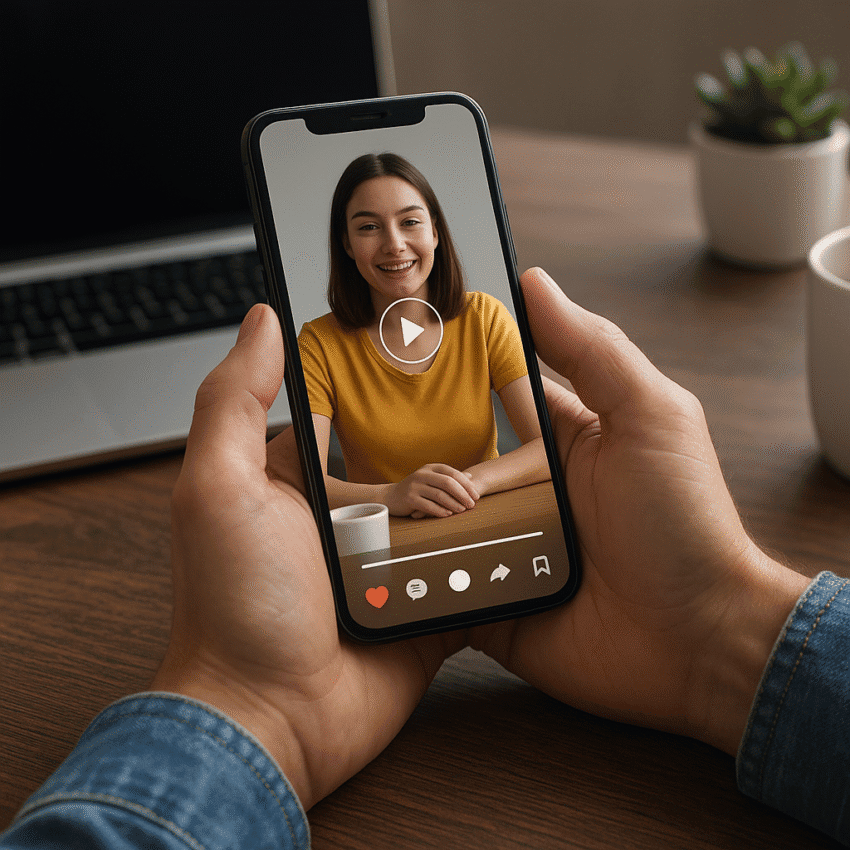
Video is the native language of social platforms and, when executed with intent, the fastest path from scroll to sale. This guide explains how to plan, produce, and distribute social videos that move people to action, with practical frameworks, platform playbooks, and measurement tactics that connect creativity to business impact. You will find proven hooks, shoppable formats, data-backed best practices, and testing plans you can plug into your next campaign to drive more conversions.
The psychology of social video and why it sells
Video reduces decision friction because it compresses proof, emotion, and context into seconds. A good clip can demonstrate use cases, counter objections, and transfer confidence all at once—benefits that static images and copy must deliver sequentially. The result: more clicks, more qualified traffic, and higher intent at the moment of choice.
Several industry studies underscore this advantage. Wyzowl’s State of Video Marketing 2024 reports that roughly nine in ten businesses use video as a marketing tool, and a large majority credit it with improved leads and sales. HubSpot’s recent research finds short-form video leading all social formats on ROI for many marketers. On the consumption side, YouTube has consistently reported that over 70% of its watch time occurs on mobile devices, a reminder to build for small screens and fast thumbs. Meta’s internal testing has long shown that adding captions increases average view time by a meaningful double-digit percentage—useful in sound-off feeds. And hosting platform analyses (e.g., Wistia) consistently observe that completion rates drop sharply as length grows, with sub-60-second content holding attention best for top-of-funnel discovery.
These data points point to a simple truth: the attention you win in the first seconds determines the downstream economics of your campaign. Strong hooks pull viewers into the narrative arc, while social proof and clear offers turn curiosity into intent. Content designed to maximize viewer retention lifts all downstream metrics: click-through rates, cost per view, cost per acquisition, and lifetime value.
Uniquely social affordances also tilt the field in video’s favor. Vertical, full-screen canvases eliminate competing stimuli; music and creator presence humanize brands; native shop features (TikTok Shop, Instagram Shop, Pinterest Product Pins) reduce checkout friction; and algorithmic feeds reward watch-time, not follower counts. Done well, this cocktail creates outsized reach and efficient acquisition—even for smaller budgets.
Choose the right conversion and map your funnel
Video success starts before a single frame is shot. Define one primary action you want the audience to take. For ecommerce, it could be add-to-cart, first purchase, or a post-purchase upsell. For B2B, it might be demo requests, trial signups, or webinar registrations. For local services, it could be call bookings or map directions. Clarity on this objective simplifies creative decisions, targeting, and measurement.
Then map a lightweight funnel and match each stage with a video job-to-be-done:
- Awareness: Stop the scroll with a visceral problem-solution hook; dramatize pain or aspiration in the first 2–3 seconds.
- Consideration: Demonstrate the product in context; show proof (before/after, comparisons, testimonials, third-party validation).
- Conversion: Reduce risk (guarantees, returns), sweeten the offer (bundles, limited-time bonuses), and make the next step obvious.
- Loyalty/advocacy: Teach advanced use, celebrate customer stories, and mobilize referrals.
Different metrics matter at each stage. Top-of-funnel thrives on thumb-stopping hooks and watch-time, mid-funnel on qualified traffic and landing-page engagement, bottom-of-funnel on checkout completion and average order value. Wire these metrics to your pixel, commerce platform, and CRM so that your attribution model reflects reality instead of vanity views.
For tracking, implement platform pixels (Meta, TikTok, Pinterest), server-side conversion APIs, and UTM parameters on all links. Align naming conventions across campaigns, ad sets, and creatives to simplify rollups. Use delayed attribution windows to catch latents (especially for high-consideration purchases), and compare platform-reported conversions with analytics suites and post-purchase surveys to triangulate truth.
Creative that sells: hooks, proof, and action
Scroll behavior leaves no room for slow intros. Within two seconds, state or show the core promise. Then sequence benefits, proof, and offer in a frictionless visual story.
Core ingredients
- Hook: Pose a challenge, flash a surprising result, or dramatize a common mistake. Match the hook to search intent and audience sophistication.
- Benefit stack: Show the top three outcomes your buyer cares about; keep copy big, simple, and legible on small screens.
- Proof: Use side-by-side comparisons, time-lapses, unboxings, UGC, and influencer demos to neutralize skepticism.
- Offer: Tie value to urgency—limited quantities, expiring bonuses, or a risk-reversal guarantee.
- Action: Place a clear on-screen and verbal CTA in the first third and repeat it near the end; make the button text match the action you want.
Scripting frameworks to speed iteration
- AIDA: Attention, Interest, Desire, Action—timeless and perfectly suited to vertical video.
- Problem–Agitate–Solve: Name the pain, intensify it with consequences, then deliver relief with your product.
- Before–After–Bridge: Contrast a frustrating “before” with a desirable “after,” then bridge with your unique mechanism.
- 3×3 method: Write 3 hooks and pair each with 3 creators or visual treatments for 9 testable variants from one script.
Format and design choices
- Aspect ratio: 9:16 for TikTok, Reels, Shorts; keep safe areas clear of UI elements.
- Text: Use bold, high-contrast supers; limit lines to 6–8 words; animate sparingly to draw the eye.
- Sound: Use trending audio where appropriate and licensed tracks for ads; always include accurate captions.
- Rhythm: Cut on movement; vary shots every 1–2 seconds until the viewer is invested, then slow down for product detail.
- Story: Anchor every shot in purposeful storytelling—who is this for, what changes for them, what do they do next.
- Presentation: Test faces-on-camera vs hands-only demos; creator presence often boosts trust and completion.
- Visual entry point: For long-form on YouTube, design clickable thumbnails that state a clear conflict or promised outcome.
Platform-by-platform playbook
TikTok
Leverage native behaviors: fast cuts, pattern breaks, and creator-led demos. Speak to subcultures with tailored hooks. Use TikTok Shop and live shopping for direct commerce; pin key products in the video. For paid, Spark Ads allow you to promote organic posts (from your account or a creator’s) while preserving social proof. Trend participation works, but evergreen educational or problem-solution content compounds more reliably over time.
Testing tips: iterate the first 3 seconds relentlessly; try three versions of the exact same video with only the opening shot changed. Watch the hold graph: aim for a strong plateau at 3–5 seconds and another at the benefit reveal.
Instagram Reels
Design for aesthetic polish and pace. Use on-screen text to frame value fast, and carousel follow-ups to deepen consideration. Tie Reels to Instagram Shop product pages; use reminders and countdown stickers in Stories to push urgency. Crosspost to Facebook Reels to unlock incremental reach among older demos.
YouTube Shorts and long-form
Shorts are top-of-funnel magnets; long-form nurtures and converts with depth. For Shorts, promise one clear outcome and deliver it in under 30 seconds. For long-form, structure chapters (intro hook, setup, deep dive, objections, proof, offer) and place a mid-roll nudge to subscribe or try. Use end screens and cards to guide viewers into your next step or to a landing page. Remember: YouTube recommendations heavily weight watch history and satisfaction, so focus on session-level value, not just clicks.
Sound-off playback remains common, so captions and large supers are critical. Feed videos featuring faces and UGC often outperform glossy brand spots. Leverage Advantage+ shopping campaigns to pair your catalog with short demo clips, and build retargeting audiences from 50%, 75%, and 95% video viewers for sequenced messaging.
For B2B, lead with a crisp problem statement for your ICP, then a vivid demo or insight. Thought-leadership clips with data, whiteboard sequences, and customer stories perform well. Use Document posts to expand on the video’s promise and include a simple booking link. Keep it human and specific; jargon kills attention and trust.
X (formerly Twitter)
Short, idea-led clips paired with a tight text hook can generate debate and curiosity clicks. Post multiple aspect ratios to test feed treatment; thread context beneath the video to capture skimmers. Consider running pre-roll against relevant creators to borrow audience affinity, and monitor conversation for questions to answer with quick replies or follow-up clips.
Idea Pins and video pins excel for step-by-step and transformation content—recipes, DIY, fashion, and decor. Optimize for search with keyword-rich titles and boards. Link directly to shoppable product pins and ensure your product feeds are healthy; Pinterest often drives high-intent traffic with long half-lives.
Distribution: owned, paid, and earned working together
Algorithmic discovery is powerful but unreliable on its own. Combine paid distribution to guarantee reach with owned channels for compounding audience and earned amplification for social proof.
- Owned: Publish a consistent cadence; collect emails and SMS to reduce platform dependency; embed videos on product pages and blogs.
- Paid: Use creator whitelisting/Spark Ads to run UGC through the creator’s handle; this frequently lifts click-through and reduces CPMs.
- Earned: Prompt customers to stitch, duet, and review; feature the best in your ads (with explicit rights).
Set up remarketing pools by watch-depth, not just views. A 75% viewer is meaningfully warmer than a 3-second passerby. Build sequences that move people from pain awareness to solution comparison to offer acceptance across 2–4 touchpoints. This is where audience segmentation translates directly into lower acquisition costs and higher purchase rates.
On the buying side, embrace creative-led optimization. Rotate hooks and creators weekly to prevent fatigue; control frequency caps to balance learning with ad wear-out; and refresh winning concepts with new angles before performance stalls.
Finally, protect trust. Community notes and comments travel fast. Prioritize authenticity: real customers, real outcomes, accurate demos, and transparent offers outperform exaggerated claims in the long run.
Production workflow and repurposing system
Great social video comes from a repeatable process, not one-off hero pieces. Build a modular workflow so one shoot yields dozens of assets.
- Pre-production: Clarify the single promise per asset; write hooks first; assemble proof (reviews, data, competitors).
- Casting: Mix creators—customers, employees, niche influencers; diversity of faces expands resonance across audiences.
- Shooting: Capture A-roll in vertical; gather abundant B-roll (hands, textures, close-ups, context) to cover jump cuts and add energy.
- Audio: Record clean mic audio even for social; it pays off in ads and long-form edits.
- Captions: Burn in accurate captions; emphasize key words with color or subtle animations; localize for key markets.
- Modularity: Film multiple variations of openings, proof points, and CTAs to recombine later.
- Brand kit: Maintain consistent fonts, color, intro sting, and call-to-action blocks for recognition without sacrificing native feel.
Repurpose systematically. Turn a 3-minute tutorial into five Shorts/Reels, a carousel, a blog embed, and email GIFs. Compile multiple UGC clips into a montage for retargeting. Extract quotes for static posts. The more surfaces you cover, the more chances your audience has to say yes.
Measurement that matters: from view to revenue
Choose a small set of metrics that diagnose performance by stage and align them with business outcomes. Avoid optimizing to vanity numbers alone.
- Top-of-funnel: 3-second view rate, average watch time, hold at key timestamps (first 3 seconds, 25%, 50%, 95%).
- Mid-funnel: Click-through rate, landing page scroll depth, time on page, add-to-cart initiation.
- Bottom-funnel: Checkout completion, cost per acquisition, ROAS, blended CAC, payback period, LTV:CAC ratio.
Instrument clearly: define success events, make sure deduplication is functioning across web and app, and sanity-check pixel fires with test modes. Use lift studies when budgets allow to measure incremental impact, and complement platform data with surveys that ask what influenced the purchase. Resist over-crediting last-click; social video often primes demand that later arrives via search or direct. Closing the loop with clean analytics elevates the entire program.
As you gather data, document learnings: which hooks pull the best audiences, which creators hold attention longest, which offers convert at the lowest CAC, and which landing pages pair best with each creative theme. This corpus becomes your proprietary edge.
Advanced creative tactics for higher intent
- Objection maps: Script direct answers to price, complexity, and trust concerns; show, don’t just tell.
- Category design: Name the “old way” and your “new way” to reframe comparisons on your terms.
- Demonstration depth: Zoom into textures, speeds, dashboards, or outcomes; specificity signals truth.
- Hybrid formats: Intercut testimonials with live demo to merge emotion and proof.
- Offers that educate: Bundle with a quick-start guide or expert session; perceived value rises without heavy discounts.
- Live video: Host product clinics and Q&A; clip the best moments for evergreen ads.
Compliance, accessibility, and brand safety
Respect platform ad policies and regional laws. Disclose sponsorships, avoid prohibited claims (especially in health and finance), and substantiate performance promises. Get written rights to reuse UGC in paid placements. Build for accessibility: accurate captions, readable contrast, and concise on-screen text. Inclusive content expands reach and reduces legal risk while improving user experience.
30/60/90-day plan to operationalize
First 30 days: foundations and fast learning
- Set goals and measurement: define primary conversion, tracking, and reporting cadence.
- Creative sprint: produce 12–20 short videos across 3 concepts, each with 3 hooks and 2 offers.
- Launch: seed organically for signal; promote best performers with small paid budgets across 2–3 platforms.
- Analyze: judge by watch-depth and cost-per-qualified-visit, not by CPM alone.
Days 31–60: scale what works
- Double down on top hooks and creators; kill underperformers quickly.
- Expand retargeting sequences using watcher depth and site behavior.
- Introduce long-form anchors (YouTube) that answer mid-funnel questions in depth.
- Test checkout and landing-page variants aligned to top creative angles.
Days 61–90: systemize and compound
- Standardize briefs, file naming, and edit templates to accelerate throughput.
- Build a creator bench with monthly deliverables; negotiate whitelisting rights.
- Run a geo or audience split test to validate incremental lift.
- Publish a quarterly insights report to steer product and messaging roadmaps.
Playbooks by vertical
DTC ecommerce
Lead with transformation: unbox, try-on, or before/after. Pair value props with guarantees and easy returns. Enable shopping in-platform wherever possible; each click removed increases completion rates. UGC plus paid Spark/whitelisting is a workhorse combo; add gift-with-purchase bonuses during peak windows.
B2B SaaS
Elevate pain clarity and demo specificity. Feature product in use with real data; avoid abstract hype. Use case studies with quantifiable outcomes. Gate deeper assets (webinars, playbooks) for lead capture, and retarget viewers with frictionless trials. Long-form YouTube content becomes your always-on sales engineer.
Local services
Show the people who will do the work, the result they deliver, and the area you serve. Include map routes, hours, and booking prompts. Blend quick educational clips (how to know you need X) with social proof (neighbors) and time-bound offers (seasonal tune-ups).
Education and nonprofits
Tell mission-first stories anchored in outcomes: who benefits, how lives change. Invite micro-actions (share, volunteer interest) and macro-actions (donate, enroll). Tie updates to milestones and show transparent impact dashboards to strengthen trust and retention.
Common pitfalls and how to avoid them
- Slow starts: Fix by front-loading the promise and cutting preambles.
- Generic value props: Replace with concrete, observable outcomes.
- Over-polish: Highly produced spots can feel like ads; blend polish with texture.
- One-size-fits-all edits: Customize by platform; what wins on TikTok may flop on LinkedIn.
- Landing-page mismatch: Ensure message and visuals continue seamlessly after the click.
- Under-measuring: Build multi-touch visibility to avoid under-valuing assist roles in the funnel.
What the data suggests about length, frequency, and cadence
Short-form earns discovery; mid-length (30–90 seconds) persuades; long-form closes complex sales. Posting frequency should reflect your capacity to maintain quality and learn fast, not arbitrary daily quotas. Many brands succeed on a rhythm of 3–5 short videos per week per platform plus one deeper weekly anchor on YouTube. Use weekly creative reviews to prune, refine, and brief the next batch while insights are fresh.
Bringing it together
High-performing social video is part science, part craft. Start with a precise promise, cast credible humans, show undeniable proof, and make the next step obvious. Let your metrics guide iteration without stifling curiosity. When the feedback loop is tight—creative to distribution to data back to creative—you build an engine that compounds attention into action.
Most importantly, build for humans first. Respect their time, speak to their real problems, and deliver value even if they never click. That generosity is noticed by algorithms and audiences alike—and it is often the hidden lever behind sustainable performance at scale.